Effective Nature article highlights big gaps in marijuana research
The science journal Nature has this effective 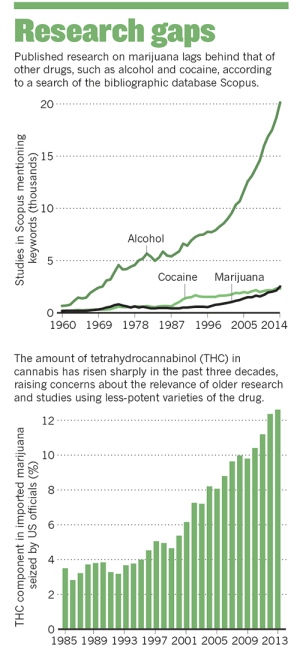
In 2013, Beau Kilmer took on a pretty audacious head count. Citizens in the state of Washington had just voted to legalize marijuana for recreational use, and the state’s liquor control board, which would regulate the nascent industry, was anxious to understand how many people were using the drug — and importantly, how much they were consuming.
The task was never going to be straightforward. Users of an illicit substance, particularly heavy users, often under-report the amounts they take. So Kilmer, co-director of the RAND Drug Policy Research Center in Santa Monica, California, led a team to develop a web-based survey that would ask people how often they had used cannabis in the past month and year. To help them gauge the amounts, the surveys included scaled pictures showing different quantities of weed. The survey, along with other data the team had collected, revealed a rift between perception and reality. Based on prior data, state officials had estimated use at about 85 tonnes per year; Kilmer’s research suggested that it was actually double that, about 175 tonnes. The take-home message, says Kilmer, was “we’re going to have to start collecting more data”.
Scientists around the world would echo that statement. Laws designed to legalize cannabis or lessen the penalties associated with it are taking effect around the world. They are sweeping the sale of the drug out of stairwells and shady alleys and into modern shopfronts under full view of the authorities. In 2013, Uruguay became the first nation to legalize marijuana trade. And several countries in Europe — Spain and Italy among them — have moved away from tough penalties for use and possession. Thirty-nine US states plus Washington DC have at least some provisions for medicinal use of the drug. Washington, Colorado, Alaska and Oregon have gone further, legalizing the drug for recreational consumption. A handful of other states including California and Massachusetts are expected to vote on similar recreational-use measures by the end of 2016.
But the rapid shift has caught researchers on the back foot. “Broadly speaking, there’s about 100 times as many studies on tobacco or alcohol as there are on illegal substances,” says Christian Hopfer, a psychiatry researcher at the University of Colorado School of Medicine in Denver. “I don’t think it’s the priority it should be.”
Despite claims that range from its being a treatment for seizures to a cause of schizophrenia, the evidence for marijuana’s effects on health and behaviour is limited and at times conflicting. Researchers struggle to answer even the most basic questions about cannabis use, its risks, its benefits and the effect that legalization will have.
The quick shifts in policies should provide a plethora of natural experiments, but the window will not be open for long. “There’s an opportunity here. Some of the most informative research we can do is right at the moment the market changes,” says Robert MacCoun, a social psychologist and public-policy researcher at Stanford Law School in California who worked with Kilmer on the research done in Washington….
As cannabis use becomes legal, the data may become easier to collect. But the drug’s use is still low compared with alcohol and tobacco, says Wayne Hall, an addiction researcher at the University of Queensland in Brisbane, Australia, so it is hard to draw firm conclusions. Marijuana may be the most popular illegal drug, he says — about 44% of US adults have used it at some point in their lives according to one source — but only about one in ten have used it in the past year. By contrast, around 70% drank alcohol in that time. “The number of people who use it with any regularity for a long time is pretty small. The longer-term consequences are really understudied,” says Hall.
A major question for researchers — and a complication in interpreting the evidence — is dosing. There are more than 85 cannabinoid chemicals in pot. The one of most interest to researchers — and users — is tetrahydrocannabinol (THC). Growers have been able to breed high concentrations of the chemical into strains of the plant meant for recreational and medicinal use. A potency- monitoring programme run by the University of Mississippi for the US National Institute on Drug Abuse (NIDA) found that THC levels have steadily increased in the United States11, from 2–3% in 1985–95 to 4.9% in 2010. The increase is even starker for imported cannabis seized by law-enforcement officials. For these drugs, potency has gone from less than 4% in the late 1980s and early 1990s to more than 12% in 2013.
But it is hard to determine the amounts of THC being consumed by the average customer. It is unclear, for example, whether users ‘titrate’ their doses, adjusting their intake according to the potency. Nicotine users are known to do this with cigarettes, but nicotine does not impair judgement in the same way that cannabis does. And the effects of THC are less immediate, especially for edible forms.
The escalating potency raises questions about previous research because users in older studies may have been consuming lower-potency cannabis, and the effects may be different. A study published earlier this year, for example, linked high-potency cannabis to a threefold-increased risk of psychosis versus non-use but found no association with lower-potency forms. And many researchers have complained that the pot approved for study in experiments funded by NIDA is a poor match for what is used recreationally or medicinally….
Although states are starting to ease restrictions on recreational use of marijuana, what got the ball rolling in changing public perceptions and the legal landscape for pot were the arguments for its medical use.
Colorado introduced its rules allowing medical marijuana more than a decade before it allowed recreational use. The amendment to the state’s constitution listed eight conditions for which marijuana was approved: cancer, glaucoma, HIV/AIDS, cachexia (a progressive wasting syndrome), persistent muscle spasms, seizures, severe nausea and severe pain. But, says Larry Wolk, executive director and chief medical officer of the CDPHE, “those are dictated by the constitution and not necessarily by medical research”.
Although there is a huge amount of anecdotal evidence — and well-organized advocacy groups that campaign for easier access to medical marijuana — there is little conclusive scientific evidence for many of the claimed medical benefits. One of the reasons for this dearth of evidence is that money generally has been obtainable only for research on the negative effects of cannabis. That is beginning to change.
When Colorado first legalized the drug, its public-health department began collecting fees from patients who applied to purchase pot at medical dispensaries. By 2014, the state had amassed more than US$9 million, most of which was ploughed back into a medical marijuana research programme selected by the CDPHE. Among the projects funded by the Colorado millions, there are two investigating whether cannabinoids can help to mitigate seizures in childhood epilepsy. Similar research is being pursued in the United Kingdom and elsewhere in the United States….
One of the biggest questions is how legalization will change usage patterns. One place in which researchers are looking for answers is Europe, where cannabis regulation tends to be much lighter than it is in the United States (see ‘Reefer madness’). In the United Kingdom, some police forces overlook cannabis use and small-scale growing operations. Spain allows private consumption, but still has restrictions on sales.
The most extreme and long-standing example is the Netherlands, which decriminalized the possession and sale of small quantities of cannabis in 1976. But although some streets of Amsterdam have been transformed into pungent tourism hotspots, the country as a whole has not changed its habits much.
Although hard data on cannabis use in Europe is patchy, the Netherlands does not have hugely more users than other nations. Data aggregated by the United Nations Office on Drugs and Crime put use in the Netherlands at about 7%. That is more than in Germany (5%) and Norway (5%), about the same as in the United Kingdom and less than in the United States (15%). Nor has the Netherlands seen a huge spike in use of harder drugs, dampening fears that marijuana serves as a gateway to more-dangerous substances such as heroin and cocaine. The message from the Netherlands, says Franz Trautmann, a drugs-policy researcher at the Trimbos Institute in Utrecht, the Netherlands, is that “a very liberal policy doesn’t lead to a skyrocketing prevalence”. Rather, cannabis is endemic, he says. “We can’t control this through prohibition. This is something which more and more is recognized.”
But the lesson from the Netherlands may be limited because the drug is still illegal, and growing and selling large quantities is still punishable by law. Colorado has gone further by legalizing not merely the drug’s use, but the whole production chain, and that could have fundamentally different effects on the economics of pot. “Legalized production really raises the prospect of a dramatic drop in price,” says MacCoun. “It’s conceivable marijuana prices could drop 75–80% in a fully legalized model.” (Although Uruguay legalized the drug in 2013, it reportedly has struggled to regulate production and to set up working dispensaries.)
The effects of a sharp drop in cost are unknown. Taxation may also have unintended consequences. If states tax by weight, users might look to higher-potency strains to save money. And once cannabis is a business, it gains a business lobby. Cannabis researchers already talk of being bombarded with e-mails from pro-cannabis groups if they make negative comments about the drug. “Marijuana research is like tobacco research in the ’60s,” says Hopfer. “Any study about harms is challenged. It’s really something.” Many fear that the big money now to be found in cannabis will drive attempts to obfuscate the risks. “If the commercial interests are too big, then the profit interest is prevailing above the health interest. This is what I’m afraid of,” says Trautmann.
Legalization provides an opportunity to answer some important questions. In a few years, Colorado, Washington and others will know (if only roughly) how legalization affects usage patterns, the number of car crashes and the number of people seeking help for drug dependency. The CDPHE-funded programmes will have added to the knowledge of beneficial effects. And continuing long-term studies of large groups of users will provide more evidence for statisticians who are attempting to disentangle correlation and causation on the negative impacts.
“When a jurisdiction changes its marijuana laws, that provides an opportunity for greater leverage on the questions of cause and effect,” says MacCoun. But, he adds, the signals will only really be clear if the laws result in a dramatic increase in use — something that is neither a given, nor necessarily desirable. “Obviously, we don’t want marijuana use to rise just to allow us to answer our questions, but if it does, we’ll be poring over all the data.”