Interesting demographic data from latest research on US marijuana opinions
Research from YouGov shows that a majority of Americans now support legalizing marijuana. 52% of Americans now support legalization, while only 34% oppose it. This is slightly up from 48% support for legalization when the question was last asked in March 2015.
Over half of all adults under the age of 65 support it, but over-65s do tend to oppose (49%) rather than support (39%) legalization. Politically, Democrats (66%) and independents (51%) want to legalize marijuana but half of Republicans are opposed. Just over a third of Republicans (36%) do support legalization, however.
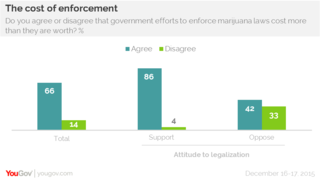
While full legalization has the support of just over half of the country two-thirds of Americans believe that government efforts to enforce marijuana laws cost more than they are worth. Unsurprisingly a huge majority of people in favor of legalization (86%) say that the efforts cost more than they are worth, but even opponents of legalization narrowly tend to say that current efforts aren’t worth the cost (42% to 33%).
As the last sentence of this summary reveals, the detailed YouGov poll results (which are available here) includes some interesting marijuana-related questions beyond just support for legalization reforms and its breaks down poll responses in some notable ways.
Of particular interest was that the only racial demographic not expressing majority support for legalization was “Hispanic” and the lowest level of support for for legalization among economic demographics was found among families making less than $50,000 per year. I tend to assume that minority populations and lower income groups are more inclined to support marijuana reform because these groups seem to be subject to a larger share of the criminal justice consequences of blanket prohibition. But this YouGov poll suggests that reality may be far more nuanced.
In addition, I find especially significant the findings and political demographic breakdowns concerning the question “Do you agree or disagree that government efforts to enforce marijuana laws cost more than they are worth?”. Notably, independents are more than five times more likely to agree (70%) than disagree (13%) with this statement, and even Republicans are more than twice as likely to agree (55%) than disagree (24%) with this statement. If other polls ask this question and produce similar result, such findings I think could well have a real impact on the positions of various presidential candidates in the months ahead.