New Pew polling shows record high public support for recreational marijuana legalization
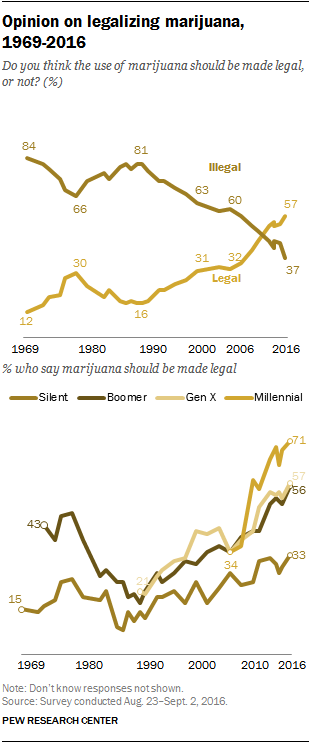
The share of Americans who favor legalizing the use of marijuana continues to increase. Today, 57% of U.S. adults say the use of marijuana should be made legal, while 37% say it should be illegal. A decade ago, opinion on legalizing marijuana was nearly the reverse – just 32% favored legalization, while 60% were opposed.
The shift in public opinion on the legalization of marijuana has occurred during a time when many U.S. states are relaxing their restrictions on the drug or legalizing it altogether. In June, Ohio became the 25th state (plus Washington, D.C., Guam and Puerto Rico) to legalize marijuana in some form after Gov. John Kasich signed a medical marijuana program into law. This November, Americans in nine states will vote on measures to establish or expand legal marijuana use.
Young adults have disproportionately driven the shift toward public support of the drug, though support is rising among other generations as well. Millennials – those ages 18 to 35 in 2016 – are more than twice as likely to support legalization of marijuana as they were in 2006 (71% today, up from 34% in 2006), and are significantly more likely to support legalization than other generations.
Support for marijuana legalization has also increased among members of Generation X and Baby Boomers (ages 36-51 and 52-70 in 2016, respectively). More than half of Gen Xers (57%) support legalization, a considerable jump from just 21% in 1990. A majority of Boomers (56%) also support legalization, up from just 17% in 1990.
The Pew Research Center survey, conducted Aug. 23-Sept. 2 among 1,201 U.S. adults, also finds persistent partisan and ideological divides in public opinion on marijuana legalization. By more than two-to-one, Democrats favor legalizing marijuana over having it be illegal (66% vs. 30%). Most Republicans (55%) oppose marijuana legalization, while 41% favor it.
Republicans are internally divided over marijuana legalization. By a wide margin (63% to 35%), moderate and liberal Republicans favor legalizing the use of marijuana. By contrast, 62% of conservative Republicans oppose legalizing marijuana use, while just 33% favor it. The differences among Democrats are more modest. Liberal Democrats are 23 percentage points more likely than conservative and moderate Democrats to favor legalization (78% vs. 55%).
As past Pew Research Center surveys have found, Hispanics are less supportive of legalizing marijuana than are whites or blacks. Hispanics are divided – 49% say the use of marijuana should be illegal, while 46% say it should be legal. Identical majorities of whites and blacks (59% each) favor marijuana legalization.
I do not find the age-based and party-based polling particulars to be at all surprising, but I do find it quite notable and interesting that this poll suggests Latinos are slightly more likely to oppose than support marijuana legalization. I suspect that this finding could and would be even more interesting and telling if the Latino responses were broken down further by age, as I suspect older Latinos might continue to recall and fear the anti-Mexican/Latino biases that were integral to a whole lot of anti-marijuana policies and rhetoric until very recently.
The interesting Pew Center finding about Latino views on marijuana legalization also provides still further reasons to pay particular attention this election cycle to the marijuana reform ballot initiatives in states like Arizona and California and Florida. In addition to wondering whether exit polling in those states might confirm the likelihood of large blocks of Latino voters ending up on the “no” side of reforms, the traditionally different Latino origins that distinguish Latino population in different states might reveal still further deep insights into whether there are actually an array of distinct policy views on these issues among distinct groups of Latinos.