
Could and should wide access to medical marijuana become the marijuana reform resting point?
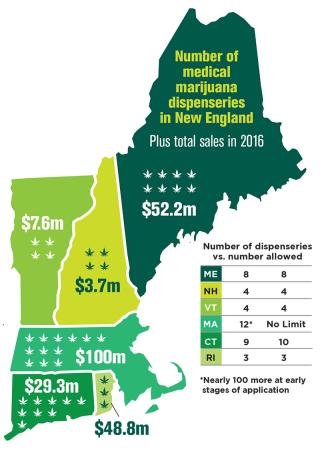
From NH Business Review, “Medical marijuana sales tick up: But NH lags behind its pro-recreational neighbors”:
If you heard three dealers in New Hampshire sold $5.1 million worth of pot last fiscal year, you might wonder how they got away with it. Yet the dealers — the three owners of four medical marijuana dispensaries — are not only operating within the law, they are just getting started.
Last fall, the state vastly expanded the number of qualifying conditions that can be treated with cannabis, contributing to a six-month, 36 percent jump to 4,753 users on Dec. 31. One projection estimates sales will quadruple to $22 million by 2021.
But New Hampshire lags behind its neighbors. The three surrounding states sold an estimated $160 million of medical marijuana in 2016 and have legalized marijuana for recreational purposes, which should produce about $1.4 billion in sales.
From Marijuana Business Daily, “More dispensaries in Massachusetts drive medical marijuana sales, patient counts higher” :
The number of operating dispensaries in Massachusetts finally reached double digits in 2017, a milestone for a program that has taken steps to bolster patient counts and witnessed a substantial boost in MMJ sales.
Over 11,000 patients were added to Massachusetts’ MMJ program throughout last year – a 34% increase – with average monthly patient growth coming in at a moderate 2.5%. However, the increased number of operating dispensaries, 19 as of December, had an even bigger impact on MMJ sales.
Patients purchased over 260,000 ounces of MMJ in 2017, an 80% increase from the 116,000 ounces sold in 2016.
Expanded access to dispensaries also prompted patients to purchase MMJ more regularly. In 2017, approximately 56% of registered patients visited a dispensary in a given month, up from 45% in 2016.