Intriguing review of latest banking realities for marijuana businesses
State and local officials in places that recently legalized marijuana are bracing for the arrival of a sector that largely runs on cash. They’re anxiously envisioning burglars targeting dispensaries and business owners showing up at tax offices with duffel bags full of money. But the marijuana industry’s banking problems may be more manageable than many officials realize.
Just ask Washington state, which last year successfully pushed almost all legal marijuana businesses to open bank accounts and pay their taxes with a check or other non-cash method. Or Hawaii, which earlier this year announced a “cashless” system for buying medical marijuana, reliant on a technology analogous to PayPal.
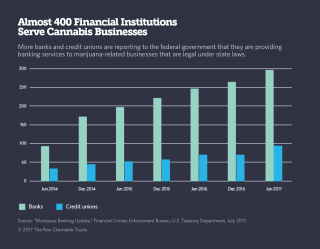
“We’re definitely seeing more businesses in the industry getting banked every day,” said Aaron Smith, executive director of the National Cannabis Industry Association, a trade group. Despite the legal risk involved in serving the cannabis industry, almost 400 banks and credit unions now do, according to the U.S. Treasury — a number that has more than tripled since 2014.
That’s reassuring news for California, where sales of recreational pot start next month, as well as for Nevada, Maine and Massachusetts, where voters approved recreational marijuana sales last year, and Arkansas, Florida, Montana and North Dakota, where voters approved medicinal sales.
But the progress that has occurred in some legal markets remains fragile. The federal government still considers marijuana to be a dangerous, illegal drug. States can only permit marijuana sales — and financial institutions can only serve marijuana-related businesses — thanks to Obama-era guidelines that create wiggle room in federal law….
Local institutions that are chartered at the state level have been particularly willing to work with the industry. In Oregon, where sales of recreational marijuana began in 2015, Salem-based Maps Credit Union decided to serve marijuana businesses after audits revealed some of its members were already in the industry. “It didn’t really square with our philosophy to kick members out,” said Shane Saunders, chief experience officer.
Taking on the new line of business required investments in staff, anti-money laundering software, and extra security at bank branches, said Rachel Pross, the credit union’s chief risk officer. Under the current federal guidance, Maps has to send a report on each marijuana-related account to the U.S. Treasury every 90 days, plus a report each time an account experiences a cash transaction of over $10,000.
Maps staff run background checks on marijuana-related business owners who want to open an account. They conduct regular, in-person inspections of the businesses whose accounts they manage, and they require business owners to share their quarterly financial statements. Dispensaries that bank with Maps make most of their sales in cash, because credit- and debit-card processors typically won’t touch marijuana money. As of October, the credit union had handled $140 million in cash deposits from 375 marijuana-related accounts in 2017, Pross said. Some companies hold multiple accounts.
In neighboring Washington, where recreational marijuana sales began in 2014, several financial institutions are openly working with the industry. Washington has helped banks and credit unions monitor marijuana-related customers by collecting and publishing extensive data on monthly sales and legal violations to the liquor and cannabis control board’s website. State regulators last year nudged marijuana licensees to open deposit accounts, aware that banking services were available and worried that cash-based businesses threatened public safety….
In some states, such as Alaska and Hawaii, regulators say they’re not aware of any credit unions or banks that currently serve the industry. Recreational marijuana sales began in Alaska in 2015, and medical marijuana dispensaries opened in Hawaii in 2017. But Hawaii is pioneering a workaround. Regulators have given a Colorado-based credit union permission to serve the state’s medical marijuana dispensaries. The credit union, in turn, has partnered with CanPay, an app that allows patients to transfer money from their bank accounts directly to the dispensary’s account….
Seattle dispensary owner [John] Branch notes that stores with ATMs make money when they dispense cash, and store owners may not embrace an electronic payment system that instead will cost them 2 percent of each transaction, as CanPay’s service does.
A change in federal law would solve the cannabis industry’s banking problem and wipe away the need for services tailored to the industry, such as CanPay. But Congress has so far failed to pass — or even seriously consider — a law that would reclassify marijuana as a less dangerous substance or allow banks and credit unions to work with businesses without risking their charters. U.S. Rep. Ed Perlmutter, a Colorado Democrat who proposed a bill on the issue this year, says no action is expected anytime soon.