“Recreational Cannabis — Minimizing the Health Risks from Legalization”
The cannabis-policy landscape is undergoing dramatic change. Although many jurisdictions have removed criminal penalties for possessing small amounts of cannabis and more than half of U.S. states allow physicians to recommend it to patients, legalizing the supply and possession of cannabis for nonmedical purposes is a very different public policy. Since the November 2016 election, 20% of the U.S. population lives in states that have passed ballot initiatives to allow companies to sell cannabis for any reason and adults 21 or older to purchase it. Although other states may move toward legalization, uncertainty abounds because of the federal prohibition on cannabis. The Obama administration tolerated these state laws; it’s unclear what the Trump administration will do.
There is also tremendous uncertainty about the net effect of cannabis legalization on public health. Most adults who occasionally use cannabis find it pleasurable and don’t experience substantial problems. There is a growing body of research on the medical benefits of consuming cannabis flowers or extracts, and legalization should make it easier to study the therapeutic potential and allow access for patients who could benefit.
But cannabis use comes with important risks. For example, cannabis intoxication impairs cognitive and psychomotor function, and there’s strong evidence that delta-9-tetrahydrocannabinol (THC), the main psychoactive chemical in cannabis, increases the risk of psychotic symptoms or panic attacks. Approximately 9% of people who try cannabis meet criteria for cannabis dependence at some point. The rate roughly doubles for those who initiate use before 17 years of age and is much higher for adolescents who use cannabis weekly or more often….
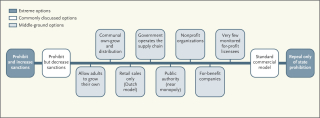
Jurisdictions considering legalizing cannabis for nonmedical purposes will have to make several decisions that could have profound consequences for public health. For example, decision makers will have to determine how cannabis will be supplied (see diagram Continuum of Recreational Cannabis Supply Options.). Allowing sales by for-profit companies is only one option. Since daily and near-daily cannabis users account for the vast majority of cannabis expenditures, many businesses will target and attempt to expand the number of heavy users. Experiences with alcohol and tobacco suggest that profit-maximizing firms and their lobbyists will eventually fight to weaken regulations intended to protect health.
Even if states allow for-profit companies to produce cannabis, local governments could limit retail sales to nonprofit organizations or sell the drug through a government monopoly. Jurisdictions less focused on generating tax revenue could simply permit home production and gifting (as Washington, D.C., does) or allow user cooperatives (an option offered in Uruguay).
Second, jurisdictions will have to decide how cannabis should be priced. The post-legalization retail price of cannabis will not only influence revenues and the size of the illicit market, it will also affect consumption. Legalizing cannabis can dramatically reduce production and distribution costs for at least three reasons: suppliers no longer have to be compensated for the risk of seizure and arrest; it allows producers to take advantage of economies of scale; and it makes it easier to incorporate new technologies into the production process. Jurisdictions seeking to ensure that cannabis retail prices don’t drop precipitously have many options. For example, they could limit production, impose costly regulations on suppliers, require a minimum price, or levy an excise tax.
Third, jurisdictions will need to decide whether to update their prevention messaging — and whether prevention campaigns will start before legal cannabis is available. They could target young people with such messages to counter commercial promotion where it’s allowed and encourage adults to talk to them about the effects of cannabis, especially on driving. Prevention also includes efforts to limit access and exposure to cannabis products. Policymakers can learn important lessons about prevention from research on alcohol and tobacco.
Fourth, given the dearth of information about the consequences associated with high-potency cannabis products and our inability to measure cannabis impairment, risk-averse policymakers may consider initially limiting access to certain types of products or imposing a cap on products’ THC content. Another option, offered by Stanford social psychologist Robert MacCoun and others, is to tax cannabis according to THC content, thereby giving jurisdictions a lever to nudge users toward lower-potency products.
Finally, since each supply option has trade-offs, some jurisdictions may want to start with a middle-ground option before embracing a for-profit model (see diagram). One strategy is to implement a sunset clause allowing policymakers to decide after a predetermined period whether to maintain the status quo or switch approaches. Since no one knows the best way to tax or regulate cannabis, creating flexible rules would make it easier to make midcourse corrections and incorporate new research and other insights into policies.
Although public health outcomes are clearly important, they aren’t the only considerations when setting cannabis policy. The costs of enforcing prohibition, racial and ethnic disparities in cannabis arrests, the size of the illicit market, impact on public budgets, and nonmedical benefits of using cannabis (e.g., pleasure, stress relief) are just a few of the other issues that warrant discussion. In addition, we should be skeptical of people who claim to know what the net effect of cannabis legalization on public health will be. Much will depend on implementation decisions, but jurisdictions’ ability to minimize health risks will also depend on how they respond to new information and other sources of uncertainty.