“After Losing Custody Of Her Son, Medical Marijuana Advocate Could Lose Her Freedom”
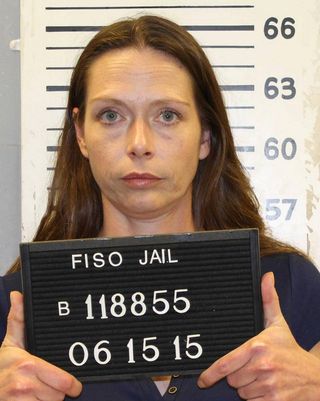
In Live Free or Die, a 2010 memoir recounting how cannabis oil saved her life, Shona Banda emphasizes the importance of “self-taught knowledge,” acquired by constantly asking questions and “looking at all of the angles of any information given.” Her son may have learned that lesson too well. Had he been less inquisitive, less prone to question authority, he might still be living with his mother, and she might not be facing criminal charges that could send her to prison for decades.
Banda, a 38-year-old massage therapist who appeared in criminal court for the first time on Tuesday, is free on a $50,000 bond while her case is pending. She was able to pay a bail bondsman the $5,000 fee necessary to stay out of jail thanks to donations from supporters across the country who were outraged by her situation. The case has drawn international attention partly because it features draconian penalties and a mother’s forcible separation from her 11-year-old son but also because of the way it started.
During a “drug education” program at his school in Garden City, Kansas, on March 24, Banda’s son heard some things about marijuana that did not jibe with what he had learned about the plant from his mother. So he spoke up, suggesting that cannabis was less dangerous and more beneficial than the counselors running the program were claiming. That outburst of skepticism precipitated a visit to the principal’s office, where the fifth-grader was interrogated about his mother’s cannabis consumption. School officials called Child Protective Services (CPS), which contacted police, who obtained a warrant to search Banda’s house based on what her son had said.
As translated by the Garden City Police Department, Banda’s son “reported to school officials that his mother and other adults in his residence were avid drug users and that there was a lot of drug use occurring in his residence.” From Banda’s perspective, what her son had observed was her consumption of a medicine that had “fixed” her Crohn’s disease, alleviated her pain, and restored her energy. “I had an autoimmune disease,” she says in a 2010 YouTube video during which she displays the scars left by multiple surgeries aimed at relieving her crippling gastrointestinal symptoms. “With Crohn’s disease, it’s like having a stomach flu that won’t go away.” But after she started swallowing capsules containing homemade cannabis oil, she says, her life was transformed. “I’m working for the first time in four years,” she says. “I’m hiking. I’m swimming. I’m able to play with my kids [two sons, one of whom is now 18]….Anything beats raising your kids from a couch and lying there in pain all day.” Banda’s personal experience aside, there is scientific evidence that cannabis is an effective treatment for the symptoms of Crohn’s disease.
As far as the police were concerned, none of that was relevant, since Kansas is not one of the 23 states that allow medical use of cannabis. In the cops’ view, what they found at Banda’s house — “approximately 1 ¼ pounds of suspected marijuana” — was contraband, not medicine. And when CPS caseworkers took Banda’s son away from her, they were protecting him, not kidnapping him. “The most important thing here is the child’s well-being,” Capt. Randy Ralston told the Associated Press. “That is why it is a priority for us, just because of the danger to the child.”
The precise nature of that danger remains mysterious. Ralston says “the items taken from the residence” — the marijuana, plus “a lab for manufacturing cannabis oil on the kitchen table and kitchen counters, drug paraphernalia and other items related to the packaging and ingestion of marijuana” — were “within easy reach of the child.” But police came to Banda’s house in the middle of the afternoon, so that detail is less alarming than it sounds. “She was producing oil during the day, while her son was in school,” says Sarah Swain, Banda’s criminal defense attorney.
So far Banda has been unsuccessful at regaining custody of her son, who is living for the time being with her husband, from whom she is separated. “He is in state custody and has been since the beginning of the case,” Swain says. “He is placed [temporarily] with the father.” A family court judge ultimately will decide whether it is in the boy’s best interest to be reunited with his mother.
But as Swain notes, that process will be “moot” if “Shona goes to prison.” The charges against her, which Finney County Attorney Susan Richmeier announced on June 5, include two misdemeanors—endangering a child and possession of drug paraphernalia—and three felonies: unlawful manufacture of a controlled substance, possession of equipment used to manufacture a controlled substance, and distribution or possession with intent to distribute a controlled substance within 1,000 feet of school property. The distribution charge, a “drug severity level 1 felony,” carries the longest maximum sentence: 17 years. Swain says Kansas law allows sentences for different offenses to be imposed consecutively as long as the total term does not exceed twice the longest maximum, which means Banda could be sent to prison for as long as 34 years. Richmeier, apparently based on the assumption that any sentences would be served concurrently, says the maximum term Banda faces is 17 years.
It seems unlikely that Banda, who has no criminal record, would receive a sentence as long as 34 or even 17 years. But a substantial prison sentence is a real possibility given the charges she faces. “When your cure is illegal,” says a caption at the beginning of Banda’s 2010 video, “you are forced to make the choice to live free or die.” If Richmeier has her way, living free will no longer be an option for Banda.